Politics Desk
Robert Kenyon's Interview With Chris Mason: A Political Car Crash With the Handbrake Off
There are bad political interviews. There are trainwreck interviews. And then there is Robert Kenyon, armed with a microphone and an alarming willingness to answer questions.
By The Editors · June 3, 2026 · 7 min
There are bad political interviews.
There are trainwreck interviews.
And then there are those rare moments when an interview becomes such a spectacular public self-destruction that future media trainers will use it as a cautionary tale while quietly updating their CVs.
Step forward Robert Kenyon.
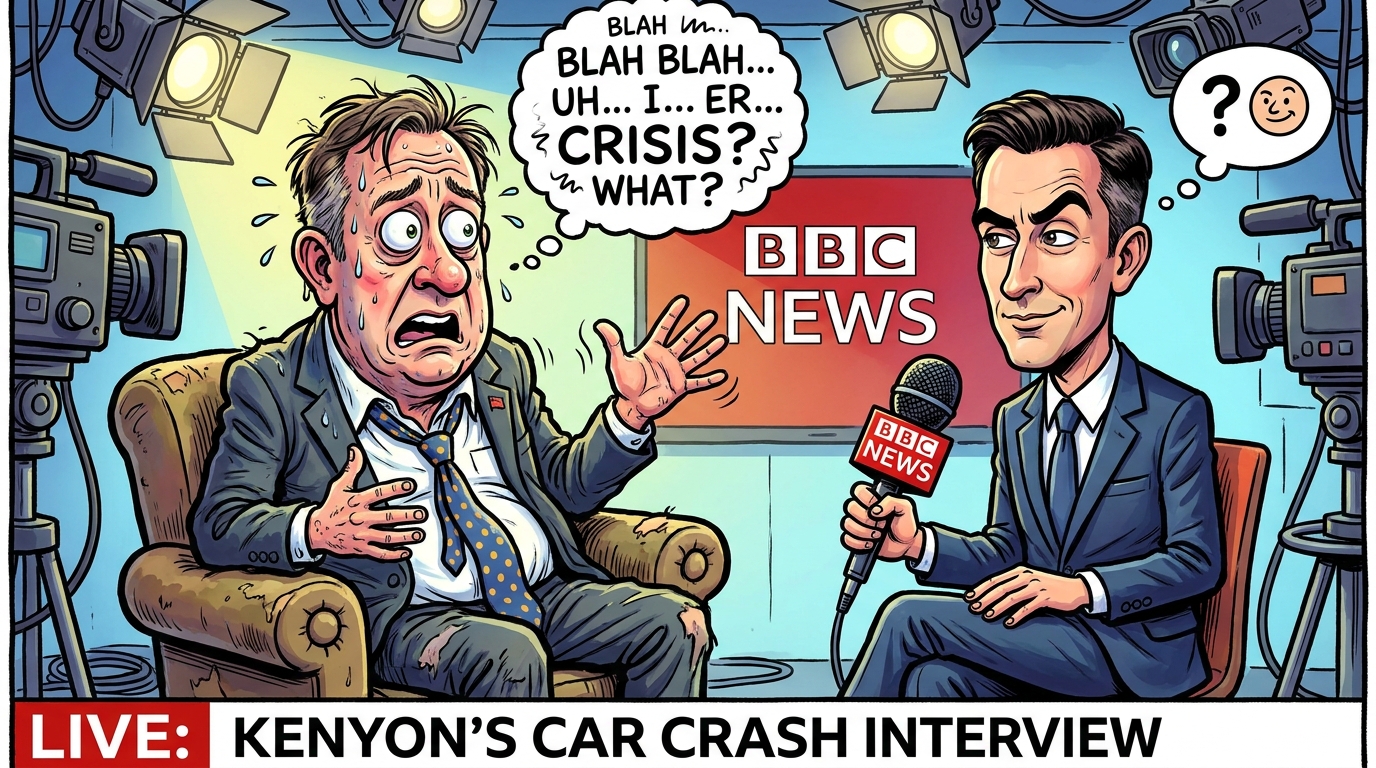
Appearing opposite BBC political editor Chris Mason, Reform UK's Makerfield candidate delivered the kind of performance that normally requires a full production team, pyrotechnics and a stunt coordinator. Instead, he managed it armed only with a microphone and an alarming willingness to answer questions.
Now, politics is full of awkward moments. Candidates occasionally forget figures, mix up statistics or accidentally "like" something on social media that later requires a lengthy statement beginning with the words, "To clarify…"
Kenyon, however, appeared to approach the interview with a different strategy altogether: contradict everything, explain nothing, and hope everyone gets distracted by a pint.
It was a bold move.
Sadly, not a successful one.
The Brexit Question
At one point, Mason calmly confronted Kenyon with previous comments about Brexit. Kenyon had criticised nationalist messaging surrounding the Leave campaign, only to then enthusiastically confirm that he himself voted for Brexit. When asked who exactly had been peddling this nationalist messaging if not the campaign he supported, the answer appeared to take an unscheduled holiday.
Watching it unfold felt rather like watching someone attempt to reverse a caravan for the first time.
On a motorway.
During a hurricane.
With their eyes closed.
The Quiet Devastation of Chris Mason
What made the exchange particularly fascinating was Chris Mason's approach. There was no grandstanding. No shouting. No dramatic television theatrics.
Just questions.
Simple, straightforward questions.
Which somehow turned out to be far more devastating.
“It's the political equivalent of being defeated by a man politely asking whether you're sure.”
Several times.
The interview also highlighted one of modern politics' most remarkable developments: the belief that deleting, denying or vaguely reinterpreting previous statements somehow works in an age where screenshots exist.
The internet remembers everything.
Every post.
Every comment.
Every regrettable late-night thought that should have remained between you and the inside of your own skull.
The result was an interview that seemed less like a campaign launch and more like an emergency audit of a candidate's entire online history.
The Lingering Question
By the end, viewers were left with a lingering question: was this genuinely the best person Reform could find for the job?
Because if the answer is yes, that raises one set of concerns.
And if the answer is no, it raises an entirely different set.
Either way, it's not ideal.
Political interviews are supposed to help voters understand candidates better.
Mission accomplished. Just perhaps not in the way Robert Kenyon had hoped.
As car crashes go, at least nobody was physically injured.
Only several campaign talking points, a handful of social media explanations, and perhaps the remaining lifespan of a few exhausted Reform press officers.
One suspects they'll be needing a very long lie down.
— Fin —