
Politics Desk
Nigel Farage, Russian Super-Hackers, and the Most Dangerous Letter in British Politics
There are few things more British than a politician discovering a national security threat immediately after awkward questions are asked about their finances.
By The Editors · May 30, 2026 · 8 min
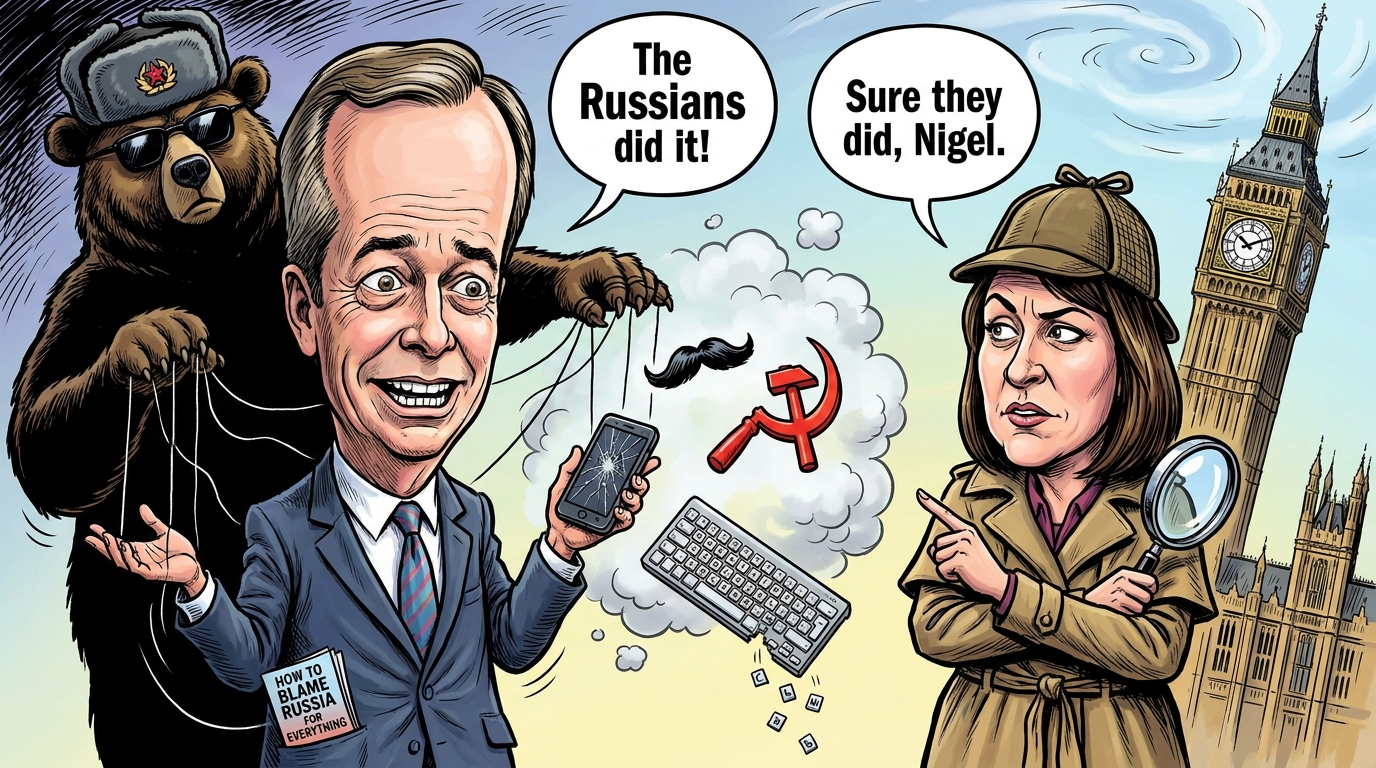
There are few things more British than a politician discovering a national security threat immediately after awkward questions are asked about their finances.
Enter Nigel Farage.
The Reform UK leader has claimed that the revelation of an undeclared £5 million gift was not the result of investigative journalism, whistleblowers, or the basic functioning of democratic scrutiny. No, apparently the real culprit was a sinister Russian cyber-operation involving hostile state actors, spear-phishing attacks, and enough espionage jargon to make a rejected James Bond script blush.
It's a remarkable defence.
Most people, when caught in an embarrassing situation, might blame a misunderstanding, a clerical error, or perhaps an overenthusiastic accountant. Farage went straight to Moscow.
Not a local hacker in a hoodie.
Not some teenager called Darren operating from a bedroom in Milton Keynes.
The Russians.
The implication is extraordinary. If true, it would mean a major British political figure was targeted in a hostile foreign cyber operation involving access to his phone, emails, and bank accounts. That isn't merely a personal inconvenience. That's the sort of thing that tends to get the attention of intelligence agencies, police forces, and people whose job descriptions involve acronyms.
Enter Anna Turley
While much of Westminster reacted with a mixture of confusion and raised eyebrows, the Labour chair produced what can only be described as the political equivalent of calling someone's bluff in a high-stakes poker game.
Her message was beautifully simple:
“If Russia really hacked you, report it.”
To the police. To the National Cyber Security Centre. To literally anyone whose job it is to investigate Russian cyber-attacks.
And if you don't, we'll do it for you.
It was a devastatingly elegant move.
Because it transformed the story from "Did Russia hack Nigel Farage?" into "Why hasn't Nigel Farage reported Russia hacking Nigel Farage?"
That's not a question you want hanging around if you're trying to convince people you're the victim of a sophisticated foreign intelligence operation.
The 24-Hour Ultimatum
Turley's 24-hour ultimatum worked precisely because it accepted Farage's claim completely at face value.
No accusations. No mockery. No argument. Just concern.
"Oh dear. Russia has compromised a major British politician's communications? That's serious. Better call the authorities immediately."
It's the political equivalent of responding to someone claiming they've seen a tiger in their garden by calmly dialing the zoo.
Suddenly the burden shifts.
If the threat is real, reporting it is obvious. If the threat isn't real, reporting it becomes awkward. Very awkward.
The result was predictable chaos. Reform initially appeared reluctant to provide clear details about whether the matter had actually been reported to the relevant authorities, prompting Labour to escalate the issue themselves to both the Metropolitan Police and the National Cyber Security Centre. Only later did reports emerge suggesting Reform had contacted the appropriate bodies.
By that stage, however, the damage had been done.
The conversation was no longer centred on the original allegation. It was centred on credibility.
The Power of a Reasonable Question
Politics often rewards complexity. The clever attack line. The intricate argument. The devastating dossier.
But sometimes the most effective tactic is a single, devastatingly reasonable question.
“If Russia hacked your phone, Nigel, why weren't the police already involved?”
Anna Turley understood something that many politicians forget: when someone presents an extraordinary claim, you don't always need to argue with them.
Sometimes you simply help them follow it to its logical conclusion.
And occasionally that conclusion arrives carrying a Metropolitan Police reference number.
As political traps go, it was exquisitely constructed.
Farage may have wanted to change the subject.
Instead, he found himself being asked to provide the homework.
— Fin —