
Politics Desk
The Delete Key Is Not a Witness Protection Programme
Reform's Makerfield candidate appears to have discovered the one thing more permanent than political embarrassment: the Internet Archive.
By The Editors · May 23, 2026 · 9 min
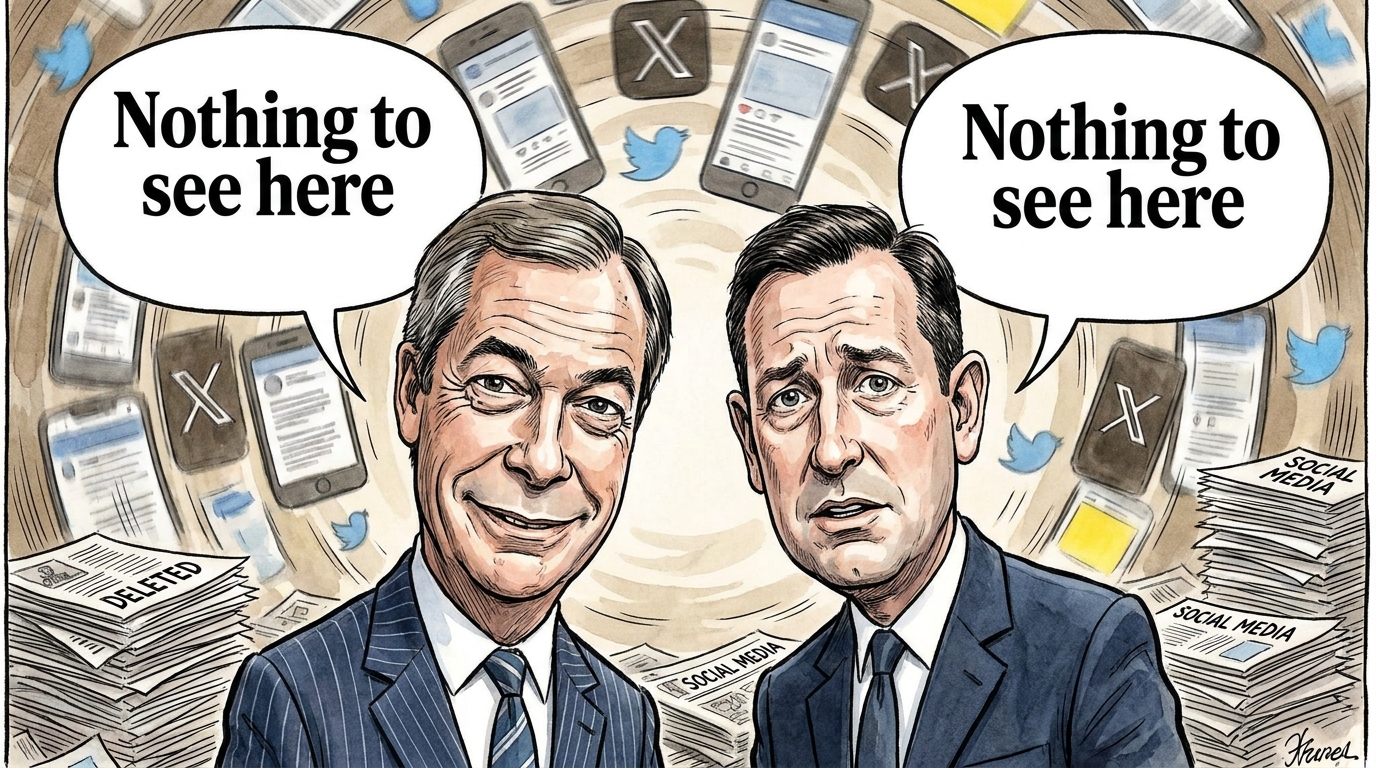
There are few things more reliably funny in British politics than a candidate deleting old social media posts and apparently believing this constitutes a full digital exorcism.
One imagines the scene.
A laptop. A nervous campaign operative. A finger hovering over "delete account". A sigh of relief. A mug of tea. A sense that the past has been safely placed in a bin bag and thrown into the electoral skip.
Unfortunately, this is the internet, not a parish noticeboard.
And the internet, unlike certain political parties' vetting departments, has a memory.
Which brings us to Robert Kenyon, Reform UK's candidate in the Makerfield by-election, a man currently learning that deleting an X account is not the same thing as deleting reality. It is, at best, putting a tea towel over a house fire and hoping the neighbours are too polite to mention the smoke.
The Account That Went To Live On A Farm
Kenyon is standing for Reform UK in Makerfield against Andy Burnham, which means the by-election has already been promoted from "local democratic exercise" to "Westminster psychodrama with leaflets".
Reform would very much like the story to be about their "local plumber" candidate taking on Labour's metropolitan machine. A classic David versus Goliath tale, if David had a suspended X account and Goliath was busy deciding whether he quite fancied being Prime Minister.
The trouble started when people noticed that Kenyon's account, @Makerfield_RFK, had been suspended by X. Not deleted in a quiet "I'm taking a break for my mental health" way. Suspended.
Metro reported that the account had been suspended for violating X's rules. The precise reason remains unclear, because X now operates like a malfunctioning vending machine owned by a Bond villain, but archived posts from the account have since been examined by journalists.
Byline Times reported that it found 419 archived URLs for the account via the Internet Archive's Wayback Machine. Which is quite awkward if your general campaign strategy relies on voters believing that "gone from X" means "gone from the known universe".
It does not.
It means someone needs to type a few words into the Wayback Machine.
This is less "deep state conspiracy" and more "basic GCSE computing".
The Wayback Machine: Democracy's Petty Little Filing Cabinet
For those unfamiliar, the Internet Archive is a public library of the web. It stores snapshots of pages over time. Politicians dislike it for the same reason burglars dislike doorbell cameras.
Byline Times said it used the Wayback Machine to examine Kenyon's suspended @Makerfield_RFK account. Those archived posts reportedly showed Kenyon repeatedly leaning into alarmist rhetoric about immigration, asylum seekers, "invasion", Southport, "two-tier policing", and the sort of culture-war sludge that now passes for serious politics if you say it loudly enough near a Union Jack.
According to Byline Times, the account posted and amplified claims during the period around the 2024 summer riots, including replies to politicians and police accounts, and engagement with figures in the right-wing online ecosystem.
Metro also reported on posts from the same account, including one where Kenyon allegedly asked whether it was a hate crime for "Asian men" to walk around Birmingham "assaulting white people en masse", and another where he reportedly said "there was never a threat from the far right because they don't really exist".
That will be news to historians, police officers, counter-extremism researchers, and anyone who has ever opened Facebook after 10pm.
There were also, according to Metro, posts about an "invasion of foreign criminals", claims of "two-tier policing", and a suggestion that the King should open up his palaces and grounds for asylum seekers.
Because nothing says "serious parliamentary candidate" quite like responding to national unrest by doing immigration Mad Libs at the monarchy.
Then Came The Second Account
Now, if this were just one account, perhaps Reform could try the classic "context" defence.
You know the drill.
“It was taken out of context. He was speaking as a private citizen. It was before he entered politics. He's just a normal bloke. Normal blokes famously post like a malfunctioning GB News comments section.”
But then Hope Not Hate reported on a second deleted account: @robkenyon1.
This is where things became less "edgy local Facebook uncle" and more "vetting department apparently replaced by a magic 8-ball".
Hope Not Hate reported that posts from the deleted account included Covid conspiracy-flavoured material, dismissive remarks about vaccines, a comparison of Australian Covid vaccination policy to Nazism, a claim that climate change is "a middle class problem", crude and objectifying comments about women, a transphobic slur, a suggestion that someone eating chips on a beach should be waterboarded, and a comment that Richard Branson and other businessmen should be hanged for taking furlough money to pay workers during lockdown.
The BBC, ITV, The Independent and The Telegraph have all since reported on allegations around posts attributed to this deleted account.
One of the most widely reported examples involved Carol Vorderman. The Independent reported that the account replied approvingly to a sexually explicit post aimed at her, saying: "He's only saying what we're all thinking."
Vorderman, understandably not overwhelmed with gratitude at being dragged into what appears to be the nation's worst plumbing-themed by-election subplot, called Kenyon a misogynist and an online abuser.
Reform, meanwhile, backed him.
Because of course they did.
Reform's Defence: "He's Not Polished"
Reform UK's response has been almost impressively Reform UK.
According to the BBC and ITV, the party said it "fully backs" Kenyon and described him as an "excellent, local candidate". It added that the comments were made before he was in politics and that he "isn't a polished, professional politician".
This is now the standard populist escape hatch.
Any time a candidate appears to have said something vile, conspiratorial, or clinically unwise online, the defence is that they are "not polished".
But there is an important distinction here.
Forgetting the name of a local school during a hustings is "not polished". Wearing a badly fitted suit is "not polished". Accidentally calling a constituency by the wrong name is "not polished".
Posting about waterboarding beach-chip eaters and allegedly endorsing explicit abuse of women is not "not polished".
It is something else.
We used to have words for this. Some of them were "unacceptable", "disqualifying", and "why on earth did nobody check this before printing the leaflets?"
Now, apparently, it is "straight-talking".
British politics has reached the stage where "straight-talking" increasingly means "said something awful on the internet and then got selected anyway".
The Great Vetting Mystery
The most baffling part of all this is not that old posts were found. That happens constantly.
The baffling part is that anyone in 2026 still seems surprised by the concept of archives.
Political parties should by now have entire departments dedicated to finding candidates' old social media horrors before the public does. It should be the first step after "Can you spell the constituency?" and before "Please stand next to this sign and pretend you have always cared about bus routes."
Instead, Reform appears to have developed a vetting system based on vibes, enthusiasm, and perhaps whether the candidate owns a gilet.
The deleted accounts were not buried under the floorboards. They were reportedly accessible through public tools, including the Wayback Machine. Byline Times even linked to the Internet Archive search for twitter.com/Makerfield_RFK*.
This is not MI5 tradecraft. It is not the Panama Papers. It is not a hidden dossier smuggled out of a Swiss vault by a man in a beige raincoat.
It is a website. A free website. A website used by journalists, researchers, bored nerds, and anyone who has ever wanted to prove that a company quietly changed its terms and conditions.
If your political crisis can be uncovered with "copy, paste, search", the problem is not the opposition. The problem is you.
And Where Is The Oppress?
Now, to be fair, some outlets have covered it.
BBC, ITV, Metro, The Independent, The Telegraph, Byline Times, Hope Not Hate and others have all carried reporting on aspects of the story. So this is not a complete media blackout.
But the wider political noise machine? Oddly subdued.
Imagine, just for one second, if a Labour candidate had a suspended X account, a second deleted account, archived posts about vaccines and waterboarding, crude comments about female presenters, and alleged interactions with far-right influencers.
GB News would have built a scale model of the account and set fire to it on air.
The Telegraph would have launched a liveblog titled "Starmer's Candidate Chaos: Latest".
The Mail would have found a neighbour, a dog walker, and someone who once saw him buying oat milk.
There would be a 47-minute panel discussion on whether "the woke left" had finally revealed its true face, followed by Nigel Farage looking grave in a studio and asking why nobody takes standards seriously anymore.
But because the candidate wears Reform colours, large parts of the commentariat appear to have developed a sudden and moving respect for nuance.
How touching.
The same people who can turn a junior Labour councillor's 2013 Tumblr into a constitutional crisis now seem curiously relaxed about a parliamentary candidate whose deleted digital footprint is doing laps around the Internet Archive with a flare gun.
This is what we might call "selective outrage", if that phrase had not already been murdered by every bad-faith pundit with a podcast microphone.
The Internet Is Forever, Especially When You're Silly
There is a lesson here for all political candidates.
Before standing for office, check your old posts. Then check your old accounts. Then check your deleted accounts. Then check the Internet Archive. Then ask someone under 40 to check again, because they will find the thing you thought was gone.
Deleting social media in 2026 is not a magic trick. It is not witness protection. It is not a baptism.
It is more like hiding a bad haircut under a hat while standing in front of twelve CCTV cameras.
The public may not care about every old tweet. Voters are not stupid; they understand that people change, language shifts, and not every historic post deserves a week-long national meltdown.
But there is a difference between an old bad joke and a pattern. There is a difference between clumsiness and cruelty. There is a difference between being "unpolished" and leaving a digital paper trail that makes your campaign look like it was vetted by a broken smoke alarm.
Robert Kenyon and Reform may hope this disappears.
Unfortunately for them, the archive has other plans.
And unlike an X account, it does not appear to suspend itself out of embarrassment.
— Fin —