Politics Desk
Nigel Farage Resigns to Face the People, Accidentally Faces a Bin
Nigel Farage resigns to trigger a by-election, only to find the establishment has gone to the pub and his most prominent challenger is a man in a dustbin.
By The Editors · July 9, 2026 · 7 min
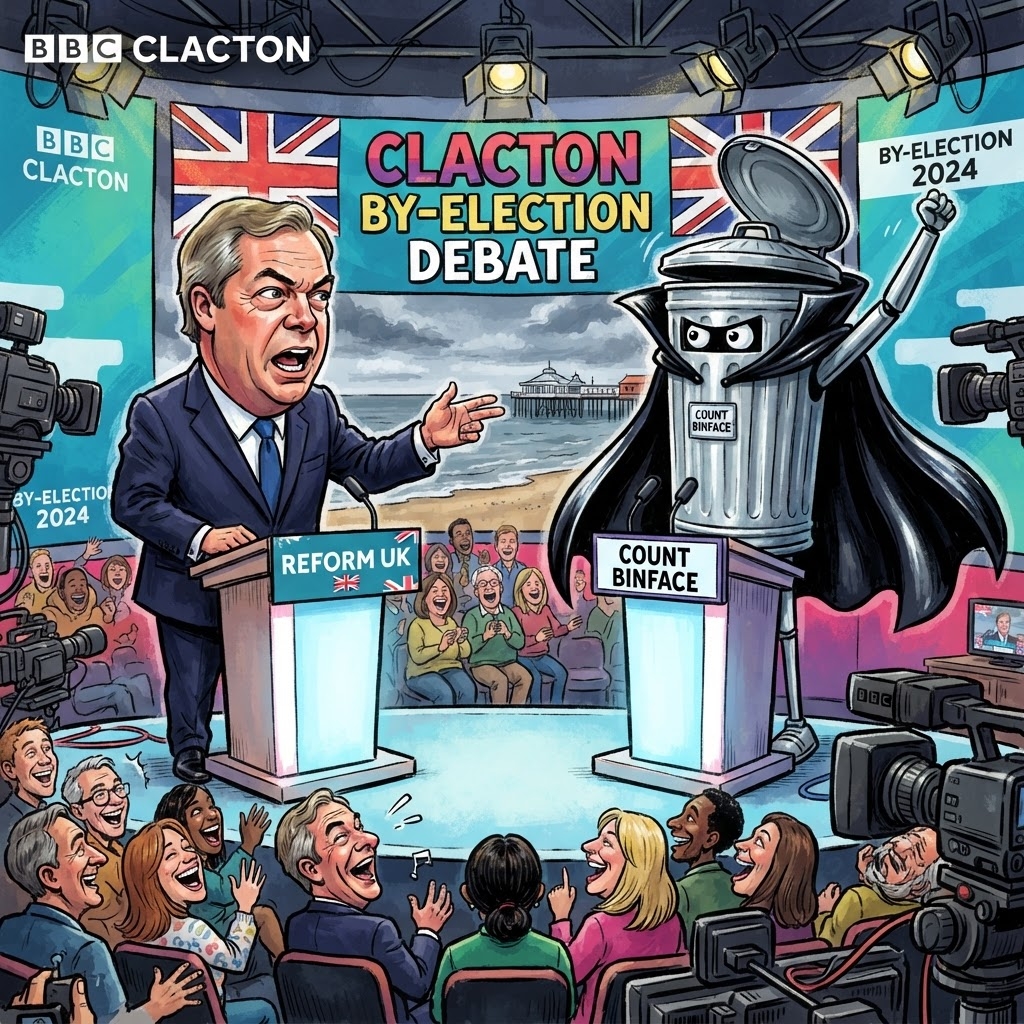
There are few things more British than a politician attempting to stage a grand democratic showdown and accidentally creating a seaside pantomime involving a man in a dustbin.
Enter Nigel Farage.
The Reform UK leader has resigned as MP for Clacton, triggering a by-election in which he intends to stand again. In his telling, this is a noble act of democratic defiance. The people of Clacton, not the Westminster establishment, shall judge him. The voters shall decide. The movement shall march on. The flags shall flutter. The cameras shall gather.
All very stirring.
Except, unfortunately, the whole thing appears to have arrived moments after awkward questions about Farage's financial arrangements became rather difficult to wave away with a pint, a grin, and the phrase "political witch-hunt".
Farage has been under scrutiny over an undeclared £5 million gift from Christopher Harborne, a British crypto billionaire based in Thailand, which Parliament's standards commissioner has been investigating. There have also been reports about support allegedly provided by George Cottrell, Farage's long-time ally, including funding connected to security and staffing.
Farage denies wrongdoing. Naturally. Politicians in these situations always deny wrongdoing. It is practically the first line of the job description, just after "own several suits" and "describe all criticism as desperate".
But the timing is doing quite a lot of heavy lifting here.
Because by resigning now, Farage has turned what could have been a dry, procedural investigation into a full-blown by-election spectacle. Or at least, that seems to have been the plan.
The People Versus The Establishment, Again
Farage has reached for his favourite costume: heroic outsider battling the shadowy forces of "the establishment".
This is a familiar production.
The establishment, in Farage World, appears to include journalists asking questions, parliamentary watchdogs doing their jobs, opposition parties noticing things, and anyone who fails to immediately accept that a multi-million-pound undeclared gift is just one of those normal working-class experiences.
The argument goes something like this: unelected bureaucrats and Westminster insiders should not decide Farage's future. The people should.
On the surface, that sounds wonderfully democratic. Who could object to voters having a say?
The problem is that voters already had a say. They elected him. Then questions arose about whether he properly declared financial interests under the rules that apply to MPs. That is not some exotic tyranny imported from Brussels in a crate of metric bananas. It is basic parliamentary accountability.
If every MP facing standards questions could simply resign, rerun their own election, and declare themselves cleansed by the sacred waters of local democracy, the entire standards system would become less a watchdog and more a decorative spaniel.
The Boycott
This is where the plan seems to have hit a pothole.
Labour has said it will not stand a candidate. The Conservatives have said they will not stand a candidate. The Liberal Democrats have called for parties to stand aside. Restore Britain has also refused to join what it called a Reform-sponsored media circus.
In other words, Farage built a boxing ring, climbed inside, raised his fists, and discovered that everyone else had gone to the pub.
This is extremely inconvenient if your entire strategy depends on looking like a fearless gladiator facing down the combined might of Westminster.
It is hard to play "people versus establishment" when the establishment has declined the invitation and left you alone with a microphone, a returning officer, and Count Binface.
Yes, Count Binface.
Because, at the time of writing, the most prominent challenger to Nigel Farage in this great constitutional struggle appears to be a satirical candidate wearing a bin on his head.
British democracy, ladies and gentlemen. Still undefeated.
The Bin Arrives
Count Binface has offered himself as a unity candidate, because apparently this timeline decided subtlety was for cowards.
And honestly, as political symbolism goes, it is almost too perfect.
Farage wanted a dramatic referendum on his integrity. Instead, he may get a contest where the central image is Britain's loudest anti-establishment showman campaigning against a literal bin.
You could commission a satirist to invent this and they would reject it for being too obvious.
There is something almost poetic about it. The man who turned politics into performance art now finds himself upstaged by an actual performance artist. The master of political theatre has booked the venue, summoned the audience, and discovered the supporting act has the better costume.
Farage's supporters will, of course, say this proves the mainstream parties are scared. They will claim Labour and the Tories are running away because they know Reform would win.
There may be some truth in the electoral calculation. Clacton is Farage territory. He won it comfortably. Reform remains a serious force in national polling. A straight fight could easily have allowed Farage to claim vindication.
Which is exactly why the other parties appear determined not to provide it.
They do not want to be extras in his campaign film.
The Scrutiny Has Not Gone Away
The crucial point is this: a by-election does not answer the financial questions.
It may change the subject. It may buy time. It may produce a summer of patriotic bunting, soundbites, and local news crews filming Farage walking past chip shops. But it does not explain why a £5 million gift was not declared if it should have been. It does not resolve the questions around reported support from wealthy associates. It does not make parliamentary rules disappear.
If Farage wins, the investigation can resume. If the investigation finds against him, the whole circus may yet roll back into town.
Possibly with more bins.
So this "let the people decide" framing is, at best, incomplete. The people can decide whether they want Farage as their MP. They cannot decide whether parliamentary rules were followed. That is what investigations are for.
This distinction matters.
Democracy is not just voting. It is also transparency, accountability, rules, records, declarations, boring forms, and people with clipboards asking deeply unglamorous questions about money.
Farage loves the first bit. The rallies. The ballot boxes. The cheering crowds. The dramatic confrontation.
He appears rather less enchanted by the second bit.
The Great Gamble
There is still every chance Farage wins the by-election easily. He may return to Parliament claiming victory over the establishment, the media, the watchdogs, the woke, the blob, the deep state, and possibly several coastal weather systems.
But the gamble has already changed shape.
This was meant to be a show of strength. Instead, it risks becoming a demonstration of absurdity.
No major party candidate. No grand Westminster clash. No heroic duel. Just Nigel Farage asking to be judged by the people while the people are offered a choice between him and a bin.
And that is the problem with political theatre. Sometimes the audience laughs in the wrong place.
Farage wanted to control the narrative. He wanted to transform scrutiny into persecution, questions into conspiracy, and investigation into electoral mandate.
Instead, he may have created the most on-the-nose image in modern British politics: a man accused by critics of trying to take out the trash, now forced to campaign against it.
Game on, Nige.
— Fin —