
Politics Desk
Britain's Local Elections: A Nation Collectively Sighs Into a Pint Glass (Part II)
The potholes remain unfixed, but Reform now controls them.
By The Editors · May 9, 2026 · 7 min
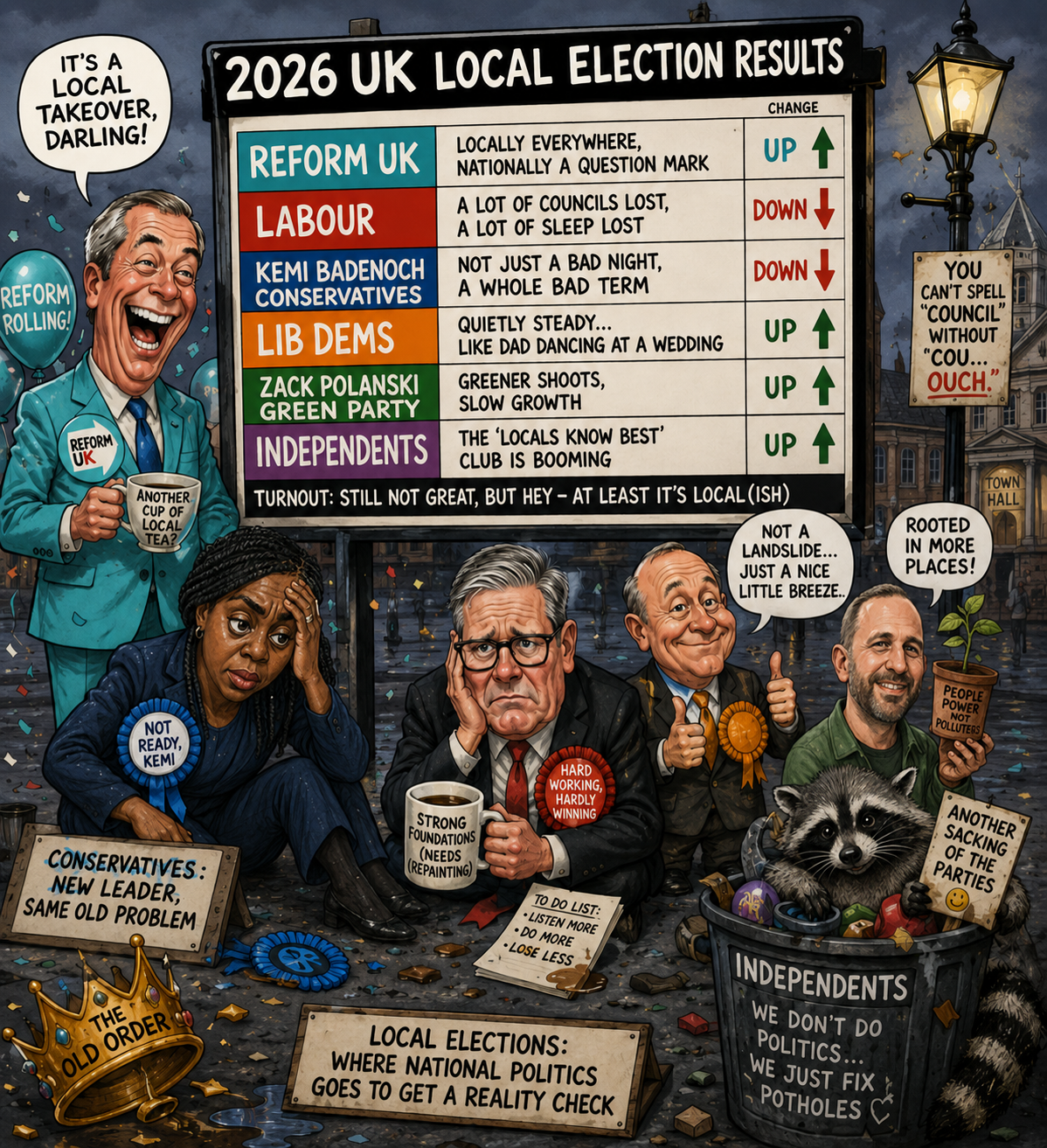
May 7th, 2026: The day Britain remembered that democracy still technically works, even if it's choosing to work backwards.
The local elections are done. The councillors have been counted. The nation's municipal infrastructure has been reallocated to parties that may or may not know what a pothole is. And in the time-honoured tradition of British politics, absolutely everyone is both vindicated and devastated simultaneously.
The Reformation
Nigel Farage has achieved what no one seriously thought possible four years ago: he's turned Reform UK into an actual political force that controls actual councils. Not in some fringe seaside town either—we're talking Sunderland. Barnsley. Essex. Norfolk. The kind of places where people have been voting Labour so long they probably have it tattooed on their forearms.
Reform gained 1,443 seats and now controls 14 councils. Fourteen. That's not a breakthrough; that's a structural realignment. Farage spent £5 million of billionaire's money and managed to do what the Conservative Party couldn't do in eighteen months: actually threaten Labour's working-class heartlands rather than just talk about threatening them.
The truly remarkable bit? He did it while barely anyone was paying attention because we were all too busy watching James Comey have a fight with seashells.
Labour's Historic Defeat, Starring Camden and Existential Dread
Labour lost 1,395 seats. Thirteen ninety-five. That's not just a bad night—that's the kind of result that makes your strategists question their entire career trajectory.
The party lost control of 35 councils. Sunderland, where Labour had been in charge since 1973, is now Reform. Barnsley went the same way. Hartlepool, Redditch, Tameside—the obituary practically writes itself.
Even in London, where Labour had mounted what looked like a recovery, the cracks were obvious. Camden held on, which Starmer will probably frame as a victory (it isn't), while Hackney, Waltham Forest, and Newham showed that even London voters are considering alternatives. The Greens took four mayoral positions. The Greens. The party famous for arguing about local recycling targets now has mayors.
“Keir Starmer looked at these results and said, without a trace of irony, that he's "not going to walk away." Mate, from where the rest of us are standing, it looks like the room is walking away from you.”
The Conservative Collapse (Still Not As Entertaining As Reform's Rise)
The Tories lost control of Hampshire for the first time since 1997. Essex. Norfolk. Suffolk. Kemi Badenoch's moment was so brief you could've missed it if you blinked while eating a Rich Tea biscuit.
Westminster and Wandsworth went Conservative again, which is essentially finding two coins in your sofa after your house burned down. Technically a win, technically not addressing the broader fire.
They lost 555 seats across the country. They're fourth in vote share. They're being out-flanked from the right by a party that barely existed a few years ago, which must be either humbling or terrifying. Probably both.
The Green Surge Nobody Really Expected to Make Sense
The Greens took 370 seats and gained four councils. More bizarrely, they now have elected mayors—actual, legitimate, verifiable mayors in Hackney, Lewisham, and they control Waltham Forest. In London.
Zack Polanski is out here winning power with a platform built on council housing and rent controls, and it's working. In places people actually live.
Hastings, Norwich, parts of Manchester—the Greens are genuinely offering an alternative in councils that aren't Labour and definitely aren't Reform. It's almost refreshing, in the way finding an honest politician is refreshing.
The Lib Dems' Customary Mixed Bag of Quiet Wins
The Liberal Democrats are doing that thing they do: winning in places nobody expected them to win (East Surrey, West Surrey, holding Richmond-upon-Thames and Kingston-upon-Thames) while simultaneously losing in places they thought they had a chance (Hull). Stockport and Portsmouth are now theirs. Sutton remains theirs.
It's competent. It's steady. Nobody's making documentaries about it.
Scotland's SNP and Wales's Great Labour Implosion
Up north, the SNP won again—a fifth straight election victory, though without majority control in Holyrood. John Swinney kept his seat. The system carried on.
In Wales? Plaid Cymru won big. Labour was pushed into third place. Its First Minister lost her seat. Reform came second in Wales. Second. In Wales.
That's the bit that really matters: Reform is not a phenomenon confined to former Labour heartlands in England anymore. It's everywhere now.
So What Actually Happened?
Britain had an election and decided it wanted something different. Not because the electorate had suddenly become ideologically coherent, but because the existing options looked bad, more bad, and slightly different bad.
Reform surged because people are angry. Labour collapsed because people are tired. The Conservatives shrunk because people have moved on. The Greens won where Labour looked too compromised. The Lib Dems held steady because nobody ever really gets angry at the Lib Dems—they're just sort of there.
Keir Starmer has nine council seats in the one place that mattered to him personally (Camden), which he'll probably take as a sign to soldier on. Parliament remains in his hands. Prime Minister's Questions will happen next week, and someone will ask him about potholes again.
And somewhere in Britain, a pothole has opened up that will finally be fixed—by a Reform councillor who's been voting Reform for six months and doesn't actually know how municipal infrastructure works.
The wheel turns.
— Fin —