Politics Desk
Labour's Leadership Panic: Because Britain Definitely Needed Another Political Circus
Sections of Labour reportedly want to challenge Starmer. Because clearly what the country needed was another governing party collapsing into psychodrama.
By The Editors · May 11, 2026 · 8 min
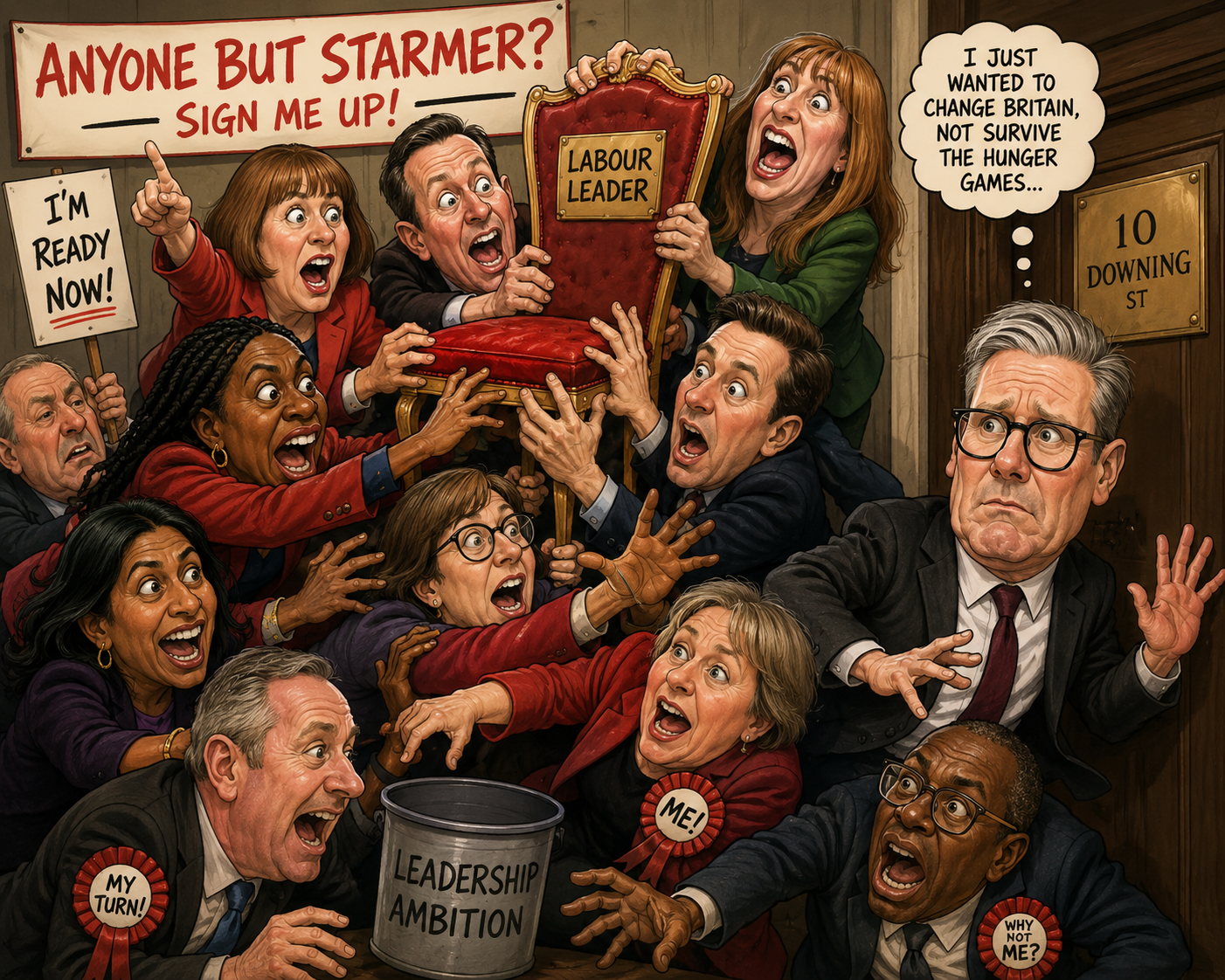
Just when you thought British politics had exhausted every possible sequel, reboot, and spin-off, the rumours start again: sections of Labour apparently want to trigger a leadership challenge against Keir Starmer.
Because clearly what the country has been missing is another governing party collapsing into an internal psychodrama while the public stare on with the exhausted expression of people trapped on a rail replacement bus service.
Now, to be fair to the plotters, Starmer has hardly set the political world alight. If charisma could be converted into renewable energy, Britain would still be dependent on Russian gas. His leadership has often felt less like a rallying cry and more like a corporate compliance seminar delivered just after lunch.
And yes, there have been mistakes. Some genuinely serious ones. Labour has spent long stretches looking hesitant, reactive, and strangely frightened of its own shadow. The government frequently communicates with the energy of a man emailing HR to ask whether enthusiasm is still permitted under updated workplace guidelines.
But even so, are we really doing this again?
Because one of the few things Britain learned from the Conservatives' decade-long leadership carousel is that constantly replacing the person at the top does not magically solve a party's deeper problems. Sometimes it just means the same dysfunction arrives wearing a different suit.
The Tories turned leadership contests into a national hobby. Britain went through Prime Ministers the way toddlers go through Peppa Pig phases. Every six months Westminster convinced itself the next person would finally restore competence, unity, and public trust. Instead, the country got the political equivalent of speed dating organised by hedge fund managers.
And now Labour appears to be eyeing the same flaming circus tent and thinking: you know what, that looked fun actually.
The Real Problem: Nobody Seems to Have Any Answers
The awkward truth is that Labour's issues run far deeper than Starmer himself.
The party's central problem is that it still doesn't seem entirely sure what it actually believes beyond "not being the Conservatives." Which, while historically a decent starting point, is not necessarily a governing philosophy capable of surviving contact with economic stagnation, collapsing public trust, and the rise of populism on both left and right.
Politics in 2026 is not operating in the cosy old Blair-era assumption that the centre ground is automatically where elections are won. Voters are angrier, poorer, more fragmented, and significantly less patient. Entire chunks of the electorate have gone from "politically disengaged" to "one bad energy bill away from voting for a bloke livestreaming from a shed."
That is the environment Labour is dealing with.
And here's the uncomfortable question nobody in the leadership challenge crowd seems able to answer: who exactly is supposed to replace Starmer?
“Seriously. Name them.”
Because whenever these conversations happen, Westminster behaves like there's a secret political messiah waiting backstage ready to emerge through dry ice and save the nation. But the Labour front bench currently resembles the management team of a regional insurance company trying to survive a difficult quarter.
There is no obvious heir apparent. No towering political communicator. No figure capable of cutting through the chaos and reconnecting with an electorate that increasingly distrusts absolutely everyone.
In fact, one of Labour's biggest struggles is that so many of its senior figures sound as though they're permanently worried about saying the wrong thing rather than passionately trying to say the right thing. Modern political communication has become so focus-grouped and sanitised that interviews often sound like hostage videos filmed inside a consultancy firm.
Meanwhile, populists thrive precisely because they sound emotional, certain, and willing to smash things.
Britain's Political Mood Is Darker Than Westminster Understands
The real danger for Labour is assuming voters are simply waiting for a more polished version of managerial politics.
They aren't.
Britain feels exhausted. Public services are crumbling. Housing is broken. Wages have stagnated. Younger generations increasingly view home ownership the same way medieval peasants viewed dragons: theoretically possible, but mostly fictional.
And after years of scandal, chaos, economic pain, and performative outrage, trust in politics itself has collapsed.
This is fertile ground for populism. Not because voters are irrational, but because people eventually become willing to gamble on almost anything when the status quo stops functioning.
That's what establishment parties consistently fail to understand. You cannot counter populist movements simply by offering calmer PowerPoint presentations. If people feel ignored long enough, eventually they stop caring whether the alternative is risky.
Labour's leadership debate therefore feels oddly detached from the scale of the moment. Westminster is once again obsessing over personalities while the public mood becomes steadily more volatile underneath them.
Changing leader might briefly excite political journalists, but unless Labour can actually articulate a vision that feels bold, coherent, and emotionally convincing, it risks discovering that voters don't just want managerial competence anymore. They want belief. Direction. Energy. Something that feels larger than carefully managed decline.
The Endless Westminster Bubble
Perhaps the most frustrating part of all this is how predictable it feels.
Every few years British politics disappears into another elite Westminster psychodrama while ordinary people watch from the outside wondering whether anyone in Parliament has noticed the country itself is wobbling alarmingly.
Leadership speculation becomes its own self-sustaining ecosystem. Anonymous briefings. Strategic leaks. MPs behaving like contestants on a reality TV show for people who own too many lanyards.
Meanwhile, outside SW1, most voters are simply trying to survive rent, mortgages, childcare costs, collapsing infrastructure, and supermarket prices that now require the financial planning once associated with buying a yacht.
There is something deeply surreal about politicians obsessing over internal positioning while the country increasingly resembles a nation being held together with expired Blu Tack.
So What Happens Next?
Honestly? Probably more rumours, more briefing wars, and more political journalists tweeting phrases like "sources close to senior figures" as if they're decoding the Cuban Missile Crisis.
But Labour should be careful.
Because while Starmer may not inspire huge enthusiasm, voters may dislike the idea of endless internal chaos even more. The Conservatives already demonstrated how quickly leadership instability destroys public confidence. Recreating that model with a red rosette attached is not necessarily the masterstroke some MPs imagine.
At some point Labour has to decide whether it wants to become a serious political movement capable of responding to Britain's deep frustrations — or merely another Westminster machine endlessly rotating managers while hoping nobody notices the building is on fire.
Right now, they look less like a confident government confronting a difficult era and more like a group project where everyone quietly agrees the presentation is doomed, but nobody wants to say it out loud first.
— Fin —