
Politics Desk
The Most Republican Man in the Capitol Was the Literal King
King Charles III came to Congress to praise checks, balances, alliances, and constitutional seriousness. Donald Trump responded by turning the visit into a knockoff coronation fantasy.
By The Editors · May 3, 2026 · 9 min
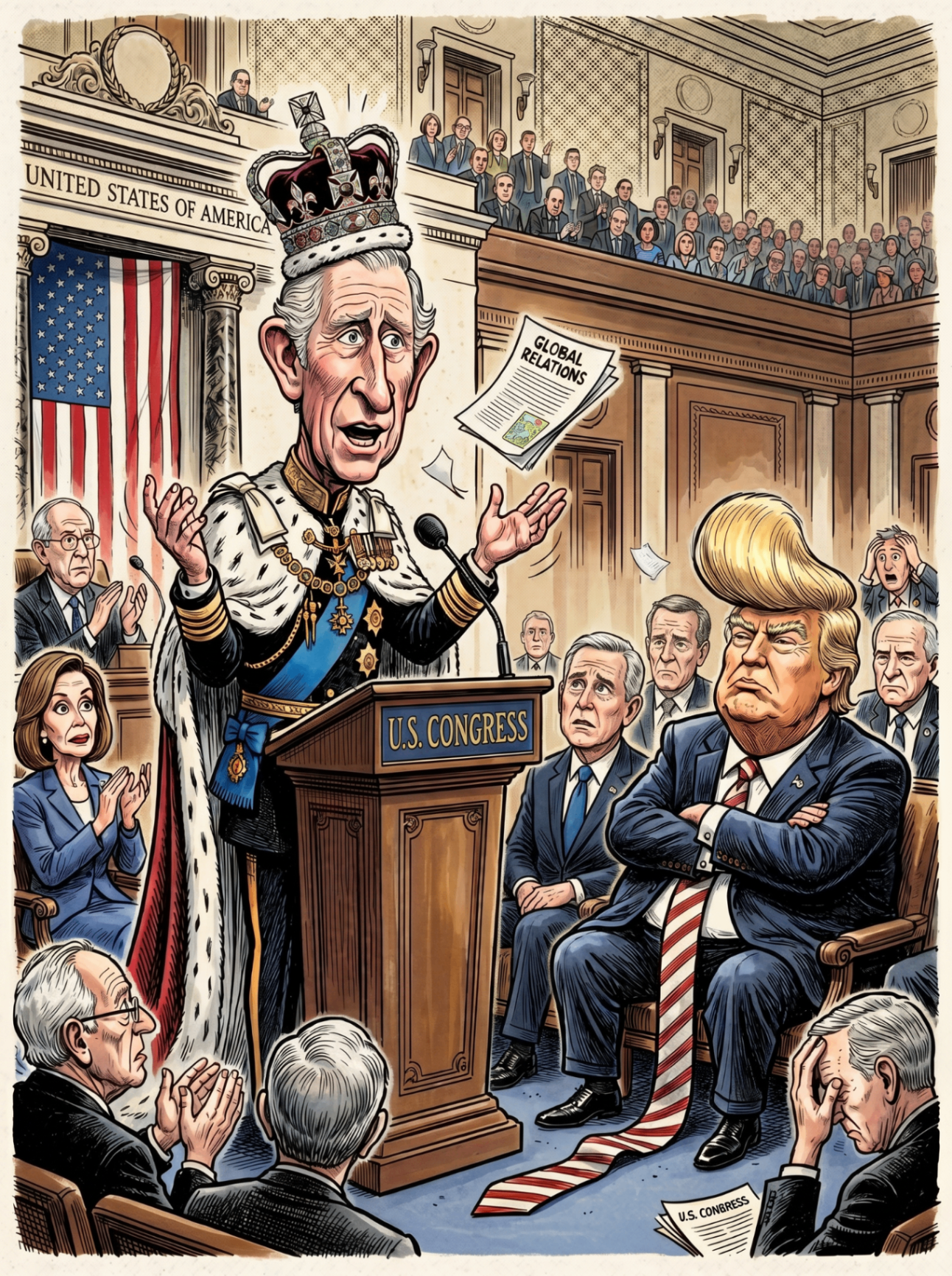
There are ordinary political embarrassments, and then there are national humiliations so complete they deserve their own commemorative stamp. America, a country founded in part on the proposition that kings can get stuffed, has now declined to the point where a British monarch must cross the Atlantic and gently remind Congress that power is supposed to have limits. That was the true comedy of King Charles III addressing the United States Capitol: a hereditary sovereign arriving to explain constitutional restraint to a republic that increasingly treats it as an optional extra.
On paper, the speech was a celebration of the Anglo-American alliance in the 250th year of American independence. In substance, it was a velvet-lined intervention. Charles praised democracy, invoked NATO, urged continued resolve over Ukraine, warned against becoming "ever more inward-looking," and stressed the ancient principle that executive power is subject to checks and balances. In other words, a man born into monarchy came to Washington to explain why elected leaders should stop acting so monarchical.
A King Lecturing a Republic on Restraint
The symbolism could hardly have been more savage. Charles, an actual king, used his moment in Congress to defend institutional limits. Donald Trump, an elected president, has spent years behaving as though the Constitution were a branding inconvenience and public office a mirror with motorcades. One man wore the trappings of monarchy while speaking the language of republican restraint. The other wore the trappings of democracy while radiating the emotional energy of a man who would absolutely commission a heroic equestrian statue of himself if someone told him it polled well.
The most lethal thing about Charles's speech was that it was funny. He opened with Oscar Wilde's line that Britain and America have everything in common except language. He joked that American independence was "just the other day" by British standards. He even reassured Congress that he was not mounting a "cunning rearguard action" to restore British rule. These were not throwaway pleasantries. They were the remarks of a man who understood the absurdity of the moment and had the confidence to let the absurdity breathe. It was wit doing the work of diplomacy, irony pressed into public service.
"TWO KINGS" — A Caption for the Era
Trump, inevitably, took that absurdity and tried to upholster it. Reuters reported that the White House posted a photo of Trump and Charles captioned "TWO KINGS." That phrase should be preserved in amber as the perfect summary of the Trump era: too stupid to be satire, too revealing to be dismissed as a joke. At a moment when "No Kings" protests have become a recognizable feature of the political mood, the White House somehow looked at a state visit from an actual monarch and thought the best possible message was, yes, exactly, there are two of them now.
“He craves the look of majesty without the burden of dignity, the optics of history without the discipline of service.”
That is Trumpism in a single image: the inability to distinguish grandeur from décor. Trump loves gold, columns, portraits, salutes, processions, and giant symbolic nonsense, but only in the way a provincial casino owner loves Versailles. He craves the look of majesty without the burden of dignity, the optics of history without the discipline of service. He does not admire monarchy because he understands ritual. He admires monarchy because it looks expensive and involves a lot of people standing up when you enter the room.
A Velvet Truncheon Aimed at Strongman Politics
Which made the wider context all the more embarrassing. This was not a random ceremonial excursion but a visit unfolding amid real tensions over Iran, NATO, Ukraine, and the broader state of US-UK relations. Charles's task was to steady the atmosphere, flatter the Americans just enough, and remind both countries that alliances are supposed to be deeper than the neuroses of the current news cycle. He arrived carrying history, discipline, and diplomatic ambiguity. Trump, as ever, arrived like a man trying to convert the entire event into a campaign poster for a country that does not technically have a throne.
The BBC noted that Charles's remarks on checks and balances drew especially strong enthusiasm from Democrats. Imagine the full shame of that scene. One side of the chamber heard a king defending constitutional limits and thought: finally, an adult. The other side applauded the pageantry while pretending not to notice that, in substance, the speech was a velvet truncheon aimed directly at the forehead of strongman politics. It takes a very special kind of national decline to make a British monarch sound like the clearest advocate for republican government in the room.
Then came NATO, transatlantic solidarity, and Charles's reminder that Article 5 was invoked after 9/11, the only time the alliance has been activated in defense of a member state. He framed alliances as obligations, inheritances, and serious moral commitments. Trump has long treated alliances like hotel amenities: useful when flattering, annoying when costly, and always subject to a tantrum over who is paying. Charles described adulthood. Trump continues to describe, mainly by example, what happens when vanity gets nuclear codes.
Charles even managed to bring up climate, because unlike much of the American right he appears to have noticed that the planet is not a liberal rumor. Reuters reported that this drew more muted applause from Republicans, which feels almost too on-brand to satirize. Nothing alarms the modern conservative imagination quite like the suggestion that reality may continue existing even after they have denounced it as woke.
Outclassed in the Register Trump Covets Most
What made the whole spectacle truly devastating was not that Charles outclassed Trump. Plenty of people outclass Trump. Librarians outclass Trump. Mid-level funeral directors outclass Trump. The sting was that Charles outclassed him in the register Trump covets most: grandeur. Trump wants the throne, the procession, the portrait, the awe, the hush, the collective intake of breath when he enters a room. But he cannot stop turning majesty into showroom vulgarity. He wants to be kingly without ever submitting to the disciplines that make authority look real.
And so the day produced its final and perfect humiliation. One actual king, constrained by ritual, custom, and centuries of institutional training, came to Congress and spoke the language of limits, duty, and democratic seriousness. One elected American president hovered around the event projecting the restless vanity of a man still furious that the Constitution did not come with a crown. Charles arrived as a symbol and behaved like a steward. Trump arrived as an officeholder and behaved like an influencer for authoritarian aesthetics.
That is the lasting image of the visit. Not friendship. Not pageantry. Not even diplomacy. Just a republic so deep into its own delusions that it took a British monarch to walk into Congress and say, with exquisite politeness, that perhaps the nation founded to reject kings should stop producing so many men who desperately want to be one. Charles joked that he was not there to reclaim the colonies. He did not need to. Trump has spent years demonstrating that if America ever loses the republican plot entirely, it will not be because Britain took the country back. It will be because one vainglorious huckster wrapped himself in gold leaf, called it greatness, and convinced enough people that dignity was elitist but delusion felt authentic.
— Fin —